
Daddy Issues
Fatherhood on film in 2025

There was no bigger driving force for film in 2025 than daddy issues: specifically the issues that dads themselves are having being dads. A significant portion of last year’s major releases featured fathers as protagonists as they navigated what exactly it means to be a good father or, more often, what it means to be a bad father.
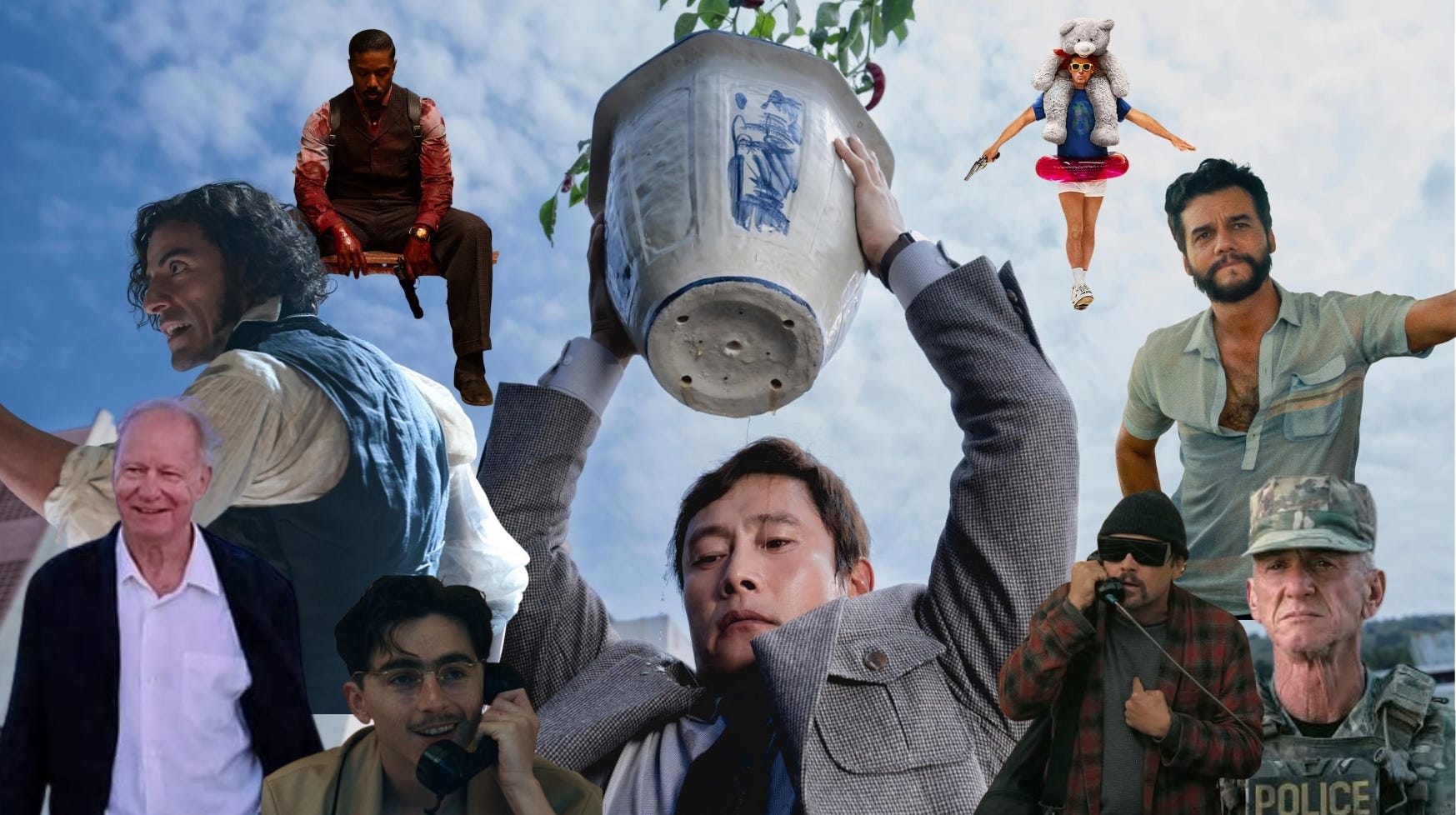
This focus on fatherhood is a manifestation of the wider masculinity crisis happening across the globe: what it means to be a modern father is intrinsically related to what it means to be a modern man. In the age of looksmaxxing and far-right podcasters, masculinity has become equally hostile to both those who identify as masculine and those who don’t. I went back and forth on writing something like this lest I accidentally sound like a men’s rights activist, but the truth is that all of us are impacted by the way men interpret their own masculinity and what that means. So although parenthood in general was a hot topic on big screens this year, with If I Had Legs I’d Kick You and Die My Love both exploring the brutality of motherhood, I want to talk about dads.
I first started thinking about the fathers on film when I saw Frankenstein—Guillermo del Toro’s adaptation has an unmistakable daddy issues angle that is not at all present in the book. His choice to make Victor’s father into an abusive doctor who expects his son to follow in his footsteps, to have undeniably father/son-like moments between Victor and the creature after he comes alive, and to make the creature so childlike at his inception is a very Freudian take on a novel that struggles more with God the father than the earthly father. It’s a distinctly modern, therapized take on the story: Victor is a bad dad to his monstrous son because he had a bad dad. He perpetuates the cycle of abuse, shifting from victim to abuser as he assumes the role of the father.
But hating your kid is not the only way to fuck them up! Loving them in a convoluted way, trying to provide for them at any cost can fuck them up too. Interestingly enough, two films that are vastly different share that premise: No Other Choice (the biggest Oscar snub of the year) and Roofman (a movie that five people saw so tbh probably doesn’t belong in this roundup but I’m a Channing Tatum ride or die). Both movies are about a financially destitute father who turns to a life of crime in order to provide for his children. The crimes are different and their outcomes are different, but the situations are startlingly similar despite their different origin countries and inspirations, showing the nearly universal role of father as provider. In both movies there’s an implicit assumption that if the father cannot provide, he is a failure of a man, and that it is better to rob several McDonalds or commit several murders than to be a failure of a man.
It’s interesting that two very different films focus on the pressures of fatherhood in that specific way, because it echoes the refrains of the manosphere: you must be an alpha, you must get money, you must provide, your wife must not work. This completely ignores the normalization of the dual income family, the fact that modern women are often equally (or even more) involved in their families financial success or failure. And to be clear, neither of these movies positions these men and their pathological need to provide as good fathers, but rather that their morality has been twisted out of a sense of masculine duty.
The idea that financially providing for children is more important than emotionally providing for them is a major aspect of Sentimental Value, in which Gustav Bog (Stellan Skaarsgard) is an emotionally neglectful, financially successful deadbeat, consistently prioritizing his art and film directing career above his two daughters, Nora and Agnes (Renate Reinsve and Inga Ibsdotter Lilleaas). Nora and Gustav spend the film wrestling with their relationship but the end is hopeful and touching: despite his absence, he loves and inherently understands her, even if the way he does it is frustrating for her. They find common ground in art, in the telling of his own traumatic childhood.
Similarly absent, though for a better reason, is The Secret Agent’s Armando (Wagner Moura), a professor in 1970s Brazil who is in hiding from a corrupt corporation. His young son Fernando must stay with his grandparents for his own safety until Armando can secure papers to get them both out of the country. His motivation throughout the whole film is to save Fernando in order to eventually be able to live with him again. In the end he does not live or succeed, but Wagner Moura returns at the end of the film to play now-adult Fernando. Fernando feels estranged from his father, making it an impactful casting choice—though he doesn’t feel a paternal connection there still is one. His father loved him deeply and his life is the legacy of that.
So much of fatherhood, and specifically the way men think about fatherhood, is legacy. The passing down of the family name, the spreading of the seed. Again this is an obsession of the manosphere: the pro-natalist movement wants to pass down the genes, to repopulate the earth with the “right” type of DNA without thinking about the resulting children as people themselves. One Battle After Another’s cartoonishly evil Colonel Lockjaw (Sean Penn) is plagued by his decision to have sex (and reproduce) with a Black woman, a choice that disqualifies him from the White Supremacist society called The Christmas Adventurers Club. He has committed their cardinal sin of repopulating with the “wrong” type of DNA, and he must undo his mistake by killing his daughter, Willa (Chase Infiniti), though he has never met her. Lockjaw’s foil in OBAA is the man who raised and loves Willa, Bob (Leonardo DiCaprio), a bumbling pothead who spends the whole movie trying desperately to rescue his daughter and yet does absolutely nothing to accomplish that, leaving the saving to the more competent members of the cast. They’re both deadbeat dads in their own way: one who provides love but little parenting, one who only provided sperm and resents her very existence. But despite biology, there’s no question that Bob is her real father. Despite the fact that she must become a parentified child, he loves her, and has (in his own way) spent his life providing for her. To be a father is to love and to care, Paul Thomas Anderson says, even if you’re kind of a dumb idiot. It’s a fitting place for fatherhood to fit into a movie that highlights community’s importance over all else; it’s Willa’s community that saves her from Lockjaw in the end, after all, and that community is something that Bob gave her.
Of course it’s impossible to talk about fatherhood in 2025 film releases without talking about one of last year’s most debated moments in film: the ending of Marty Supreme. Marty meets his newborn baby after spending the majority of the mother’s pregnancy insisting that the baby isn’t his, completely shirking the responsibilities of fatherhood in order to pursue greatness via ping pong. He ends the film face to face with his baby after identifying himself as the father to a nurse, and he weeps. Is it because of the child? Is it because he just accomplished his greatest goal, beating the best tennis table player in the world, and it changed nothing? There have been hundreds of interpretations of this moment but mine is that it is both, it is a sort of grief over the fact that big moments never feel as big and never last as long as you’d like them to, but the birth of a child, a big moment that is the catalyst for a new identity and lifestyle, completely shifts the perspective you have on all the big moments before that one. Marty grieves the life he thought he would have but the grief is tempered with love and hope. Marty, who has only ever done anything for himself, is now faced with doing something and being something for someone else. Will Marty end up as a deadbeat dad? Probably. But in that one moment, he is there and he is promising to continue to be there.
The grief of fatherhood shows its head in Sinners as well, but the other side of the coin, the grief of Smoke (Michael B. Jordan 1) and Annie (Wunmi Mosaku)’s lost infant daughter. Their grief hangs in the air between them as they navigate their love and estrangement. But despite the loss of his daughter, Smoke continues to be a father to those around him, namely to Sammie as he advises him to abandon music in order to live a more moral life. It’s a classic tale of a father wanting his child to have a life better than he had, even if Sammie isn’t really his child. Smoke is the movie’s ultimate father figure: protecting Stack, Sammie, and everyone else in their community. He is fighting for them until the end, until even after they’ve all perished. Smoke is the image of father not as provider (though he is), but as protector. This is a side of modern fatherhood that’s so often either weaponized or forgotten. Kindness, courtesy, gentleness has no room in the increasingly violent masculinity of today. And that’s not to say Smoke isn’t violent, but in the film he is violent only in defence of the people he loves. That he spares Stack (Michael B Jordan 2), Mary (Hailee Steinfeld) and, in a different way, Annie, shows his gentle side. He does not want to hurt the ones he loves.
Both Marty Supreme and Sinners grapple with a type of grief in fatherhood (though I don’t mean to compare the grief of losing a child to the grief of gaining one) as well as fatherhood as identity. When women have children they are pressured to make motherhood the largest part of themselves, but men are rarely held to the same expectation. But doesn’t having a child change you? Doesn’t losing a child change you even more? How can a man with an iron clad grip on his traditional understanding of masculinity, as both Marty and Smoke are, allow himself to be so changed by the softness of a child?
None of these films have answers for the masculinity crisis or to the question of the right way to be a dad. There is, of course, no right way, which is kind of the issue all these dads are having. Everyone has a dad (at least biologically) and yet every single person has a different experience of having a dad. It’s a relationship so vast that it would take millions of movies to aptly cover fatherhood. Among all of the dads on-screen this year, the best father of the year is not biological, it is Wake Up Dead Man’s Father Jud, who leads his flock with love and forgiveness, who opens his arms to all. He is the type of father all the children implicated in the fatherhoods above would have loved to have, someone nurturing and kind and emotionally available. There’s no one right way to be a father, but Father Jud does a pretty good job.
This is so wonderful. Insightful & an avenue I’d love to hear more from!
Finally someone said it! Haven’t been able to stop thinking about how across the largest guilds and Oscars, the 5 movies with the most nominations are all about Daddy stuff on many levels. Love this.